
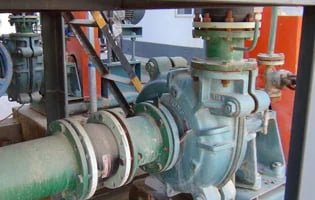
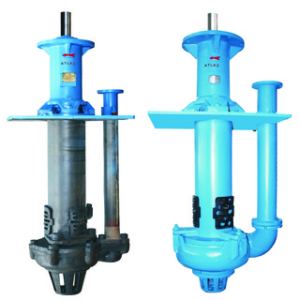
Slurry pumps have a wide range of applications, used in mining, power generation, metallurgy, coal, and environmental protection industries to transport slurries containing abrasive solid particles. The introduction of Warman slurry pumps in the 1980s led to rapid development of slurry pump technology in my country.
Examples include the transportation of ore slurries in metallurgical processing plants, hydraulic ash removal in thermal power plants, coal slurry and heavy media transport in coal washing plants, and dredging and silt removal in rivers and waterways.
In the chemical industry, they can also be used to transport corrosive slurries containing crystals.
Firstly, in terms of applications in mineral processing plants, approximately 80% of these pumps are used in the mining industry’s mineral processing plants.
Due to the harsh operating conditions during the initial ore processing stage, the service life of slurry pumps in this section is generally short.
Of course, different types of ore have different abrasive properties. For example, in stages such as concentrate transportation, where the abrasiveness is relatively lower, the overall service life of the pump is longer.
Therefore, when users inquire about the service life of a product during the purchasing process,
strictly speaking, no manufacturer can promise a precise service life without any basis.
Because the service life of components subject to wear and corrosion depends on many different factors,
the diversity and complexity of operating conditions lead to variations in the service life of materials of the same quality.
However, during the initial selection phase, reputable manufacturers can provide reasonable design solutions based on the specific operating conditions.
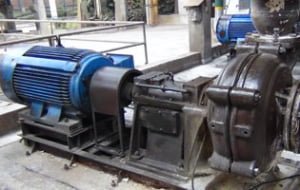
Application of Slurry Pumps in Thermal Power Plants
Due to the large amount of coal used for power generation, the slag or ash remaining after coal combustion needs to be removed.
Slurry pumps are used for ash removal. The slag, after being mixed with a certain amount of water, is transported to the ash disposal area by the slurry pump.
Therefore, slurry pumps are sometimes also referred to as ash pumps in power plants.
Furthermore, in the coal washing industry,
due to varying operating conditions, larger coal lumps and gangue are prone to causing blockages, which places high demands on the design of slurry pumps.
A coal washing plant under the Huaibei Mining Bureau adopted a specially designed slurry pump in 2005, replacing the previously imported pump from Australia. It has been operating normally ever since, transporting large coal lumps and gangue without blockages, and its wear life has exceeded that of the imported pumps.
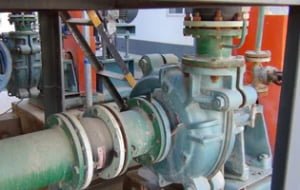
In the field of sand extraction from seawater,
slurry pumps are gradually gaining acceptance among customers.
However, when extracting sand from seawater or dredging sand from riverbeds, slurry pumps are more commonly referred to as sand pumps or dredging pumps.
Despite the different names, in terms of structural characteristics and pump performance principles, they can all be broadly classified as slurry pumps.
Therefore, in seawater sand extraction, we often call them sand pumps, while in river dredging, they are customarily called dredging pumps.
Although slurry pumps have a wide range of applications, correct application is crucial.

发表回复